Showing posts with label snark huntress. Show all posts

Thursday, March 22, 2012

Sometimes You Should Stop at the First Book: My Review of "Monsters of Men" by Patrick Ness

Recently Requires Only That You Hate, one of the best book blogs that I read (okay, so it's the only book blog that I read), put up a post about why she's done with YA. I may have recently reached my limit with YA science fiction as well, after spending my morning finishing Monsters of Men by Patrick Ness, a book that was so disappointing it made me downrate the rest of the series in retrospect, much like the third season of Star Trek to some extent invalidates the previous two seasons. A book that made me have so many strong emotions (most of them negative) that I'm breaking my ban on book blogging to write this! This is really more of a review of the series as a whole, although most of the hate falls to the third book because that's where things really fell apart. So yes, SPOILERS AHOY, although only dweebs care about spoilers.

I picked up the first book in the series, The Knife of Never Letting Go, because it won the Tiptree Award and I'm trying to read through the Tiptree Award winners because, why not? There's too much on both the Hugo and Nebula winners' list that I know I'm going to hate, so I'm never going to do a systematic read-through of either of those awards. Anyway, TKONLG centers around a religious community that colonizes a planet. When they get there, they discover two surprises: there's a native species on the planet, and they can hear the thoughts of everything in the world... except human women. We never learn why women are exempted from this involuntary telepathy (although I was desperately hoping to learn it at some point), but the effects of this exemption are more important. Men's distrust of women leads to gender segregation in some areas, all-out war in others, and in the main character's community, to gendercide, of the women by the men, although one would think that the tactical advantage of silence would give ladies the upper hand. Not so!

So the book opens with the main character, Todd, who has never seen a woman and is basically waiting to die on this crapsack world with maybe a hundred or so angry men on it. Soon, though, he learns that there's more to the world than just his town, and he meets a girl, Viola, who he believes is less than human because of her lack of Noise, yet somehow feels drawn to help her anyway. We all learn something about sexism, and there's a lot of chase and actions scenes because well, this is YA. The most interesting part of the first book for me was learning about how the other towns on New World "dealt with their women," and I bet it was these glimpses at an extreme (if invisible) sexual dimorphism through the eyes of an innocent person that won this book the Tiptree. It probably deserved it, although I don't know what else was nominated that year.

In the second book things... kinda fall apart, although not completely. The focus shifts toward two groups, the male, town-based Army of the Ask led by the mustache-twirling Mayor Prentiss, and the mostly female, woods-based Answer, who are portrayed as terrorists, although it's a justifiable terrorism. I mean, man, when a megalomaniac takes over your town for no reason other than bein' crazy, and pretty much starts right away with the business of oppressing women, who wouldn't be a terrorist? One of the things that annoyed me about the second book was that the Ask and the Answer are seen as being two sides of the same coin when, no, that's not true at all. AFAICT, the women in the largest town (Haven) were pretty much just chilling, not really being oppressed at all, when crazy old Mayor Prentiss rides in and turns their world upside down. It's hinted that it's only because of the tacit approval of the men of Haven that he's able to accomplish this takeover, but I think again, it doesn't go far enough, whether because Ness didn't want to alienate male readers or because he himself is male.

Third book, though, hoo boy. We've totally abandoned the interesting gender speculation of the first and part of the second book, and it's all about WAR WAR WAR. We also have a new first-person viewpoint character in the person of 1017, one of the Spackle, the humanoid (blah) native species of the planet who, again, have such a strong tactical and population advantage over the Earthicans that in reality this book should have been like five pages long. "There's tens of millions of Spackle to 1000 Earth beings. The end." But because the Spackle aren't a ruthless species (like human men... dunno if this was meant to be the point but that's what I took away from it), there's instead 600 pages of drawn-out battle scenes handled even more awkwardly than the battle scenes in Mockingjay (and that's saying a lot... Suzanne Collins your books are enjoyable in many ways but that city warfare is terrible!). Adding the VP of the Spackle does almost nothing for the book except reinforce that writing non-human characters is extremely difficult and something that almost nobody should try, because 99% of the time it comes off as hokey. That's no different here. Bonus points for the Spackle not being an alien stand-in for Native Americans but they don't appear to have much culture at all. It makes sense that they're monocultural, because a telepathic, quasi-hivemind species wouldn't have developed different religions or languages or rituals (it's also stated that the leader has control over the world-mind), but they don't have much of a culture, period, other than being humanoids who walk like us, ride animals around like us, fire gun-like weapons like us, etc. Writing intelligent aliens who aren't just humans in costume is really fucking hard which is why I don't do it. But hey, at least they're not Native Americans!

So anyway, both the Mayor and the leader of the Answer become pretty cartoonishly evil over the course of this book, and nobody plugs either of them, under the belief that doing so would make them (especially Todd, who is already on the road to evil due to his maleness) as bad as the adults. Uh, what? Dude, at some point, the refusal to kill isn't a virtue, it's a sickness. Anyway, there's a showdown between Todd, Viola, and the Mayor, which involves Todd and Viola flinging each others' names at him in succession, making me think of another character from a series that declined in quality as it went along:
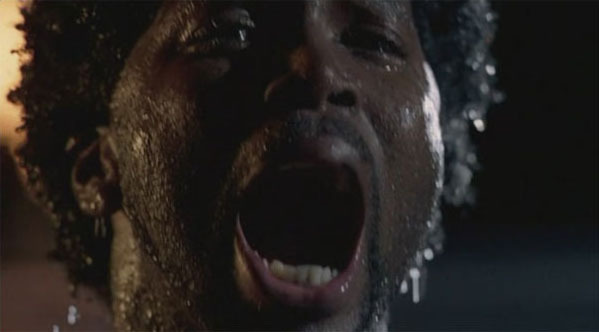
WAAAAALLLLTTTTTTtttttttt....!!!

But then came the part of Monsters of Men that I thought was inexcusable, the reason I'm writing this review. 1017 comes upon Todd and Viola on the beach after the Mayor's suicide (spoilers!) and thinks Todd is the Mayor, so shoots him. Todd is established as being dead. 1017 is shown to be devastated over this even though Todd is a member of the species who enslaved him and killed thousands of his people. (But the colonists will be good THIS time! Pinky swear!) Meanwhile, Todd comes back from the dead, and at the end of the book is in a vegetative state that we're led to believe is temporary. So basically, Ness led us down a path where the plot seemed to dictate that Todd HAD to die, he had to die to leave us with the knowledge that war can be so devastating that it can up and kill one of your main viewpoint characters, and then totally ruined that ending. What a freakin' copout, and I daresay it wouldn't have happened in a book not marketed as YA.

So yeah, the plot was disappointing, but so were a lot of other elements. While I don't like to be "that person" who whinges about improper science in my science fiction books, the question about why women don't have Noise gnawed at me and the fact that it wasn't answered was like breaking Rule #1 of creating your science fiction world. It can be a bullshit explanation (and what SF explanations aren't?), but it has to be there, or at least be commented upon. At the end, it's assumed that the men and Earth animals will join with the Spackle in some hippy-dippy communal voice that will create a peaceful paradise lasting for all time... but when Viola asks "hey, what about the ladies?" it's merely hinted that they'll, like, learn how to use Noise. Stop bothering us with your stupid questions, girlie!

Also totally missing from the book is any mention of religion, except that their religion is what caused the colonists to take the oh-so-convenient step of destroying links to Old Earth. It's gotta be Christianity due to the colonists being almost all white and the houses of worship being called "churches," but no link is made between the original religious motivation for colonization and the consequent falling apart of society due to the gendercide and resultant fallout. You know what might have been interesting? Using the church as an explanation as to why it was so easy for the men to overpower the women despite their silent advantage, because paternalistic Christianity taught them to obey men. But that would have unsettled some Christian readers, I imagine, and been too "heavy" for a YA book.

One bright spot is the fact that there are several same-sex couples in this book handled without fanfare, both human and Spackle, although I really wondered how this fits in with the fact that the colonists are supposed to be religious fundamentalists. Perhaps New World was founded by fanatic Universal Unitarians? It's cancelled out, however, by the gender essentialism: my "looking for scientific answers in a YA book" mind originally assumed that all the native species on the planet were one-sex, which would have simplified the mechanics surrounding Noise, but instead the way Noise is handled made it seem like XX human beings were some kind of freaks. I think it speaks to a lack of imagination that the Spackle race has two sexes (although they don't appear to have gender). There are apparently no trans* humans on New World so I don't know how Ness would have dealt with their Noise.

So while I could have recommended the first book gladly, I can't really recommend the series, and unfortunately TKONLG ends with a major cliffhanger. I don't think this book will put me off YA entirely, but I think that this pattern of "excellent first book, okay second book, terrible third book" is something I've seen a LOT in the YA series I've read over the past few years: the aforementioned Hunger Games, the Uglies series. The underrated City of Ember remained at a high point throughout, but it's the only example I can think of right now. So maybe the rule for YA should be, read the first, make up your own ending? That sits a little too close to fanfiction for this extremely infrequent book reviewer.

Friday, October 14, 2011

Reality Doesn't Have to Suck: That GM Ad


There was some predictable outcry over the above General Motors ad a few days ago. Basically, the ad is terrible and so is GM (for a much bigger reason than this). But, IDK, I can't get as fired up about this as others.

I think my take on it was a little skewed compared to the rest of the bikeysphere. The "Reality Sucks" line struck me at hopelessly nihilistic, and definitely connected to the car (as it's a car ad) instead of the bike. As Rob likes to tell me when I go on about hating cars and driving, driving is a reality, and it's not going away, and yes, for most people it does suck. Yet, why a company would want the term "sucks" to come anywhere near their product baffles me. Fast food is often a necessity in our modern lives, but would you see Burger King running a commercial where a family is sitting down to a nice home-cooked meal, and then there's a cutaway to a dad rushing home with a bag of Whoppers? "Reality sucks, stop cooking, eat BK." No, because it's insane to compare your product to a slower, yet far more fulfilling alternative. Likewise, cars are a tool, ones that are often a necessity in our modern lives, but being reminded of this "reality"... does not strike me as the best way to go. If anything, it might cause someone to think "Hey, yeah, driving DOES suck! Wait, you can ride a bike to work, like it's a car? Does that suck as much as driving does?" Putting your competitor's product in your ad is a risky venture, and should only be done if you're absolutely certain your product is superior. It isn't at all clear that driving in areas that allow for transportation cycling is superior (in fact, proving that it's inferior is sort of the point of bicycle advocacy, right?), so really, the main thing I take away from this is GM is a self-hating corporation which is secretly engineering its own downfall.

The pictures further fuel this interpretaton. For one thing, the cyclist is attractive! He's not really my own type, but he's definitely got that generic advertising-model look going on. And while he's not smiling, he also doesn't have a doomed expression on his face saying "oh, man, I wish I had a truck right about now." He looks like he's concentrating, which I can understand, as my own face tends to scrunch up when I cycle, to the point that I look like I'm probably not enjoying myself very much. The girl in the picture, meanwhile, is smiling at him. Not sneering, or rolling her eyes, but genuinely smiling at him, even if she's WAY too close. Meanwhile, she's not watching the road. Does this mean GM customers are bad drivers?

So, really, my deconstruction of the ad would have to be: "The reality of our current transportation infrastructure is sub-par and often requires the use of a car, which we provide. However, there are alternatives, and these alternatives may not 'suck' as much as our product or others like it. Have we said 'suck' enough? Suck suck suck, our products suck." Awesome pitch for my side, GM! Here, have another bailout.

Of course, that's not what GM was going for by a long shot, I know that. I realize that my interpretation of this ad is influenced by my own hatred of cars (despite their "reality"). Still, I wonder just what they were going for. Nobody who currently has the privilege of being able to ride for transportation is going to "make the switch" after seeing this ad. I guess it makes GM truck owners feel a little better about themselves and their choice to carry around a 3000-pound steel cage. And of course, it got us all talking about GM, which is the ultimate goal of any and all advertising.

The below response ad by Giant is pretty awesome:


Basically, the fact that a major car company even deigns to "attack" transportation cycling means just one thing to me: they're scared and we're winning. Even ten years ago, you wouldn't have seen an ad like this, because cycling was so on the margins that this ad would have been a waste of GM's ad money. Call me an optimist, but I count this as a victory.

Wednesday, April 6, 2011

The Way I Live

J.G. Ballard's High Rise is a cautionary tale of an opulent apartment complex which goes haywire when the power fails. Before long, this closed system complex (boasting pools, a shopping mall, and a school) descends into madness and decay, until before you know it, the main character is eating roast Pomeranian while watching his co-tenants die miserably. It is a truly horrifying tale of what happens when you rely on technology to take the place of human connection and a real community. When me and my husband Rob moved to Baltimore, we very narrowly missed befalling the same kind of misfortune, and now I will tell our tale of warning to you, dear reader. Be forewarned!

We went into The Promenade totally blind and without an appointment, knowing only that it was an apartment building, and sort of a fancy one, at least based on the exterior and the name. But we were running out of potential places to live in Baltimore, and figured that a building would likely have openings. To set the scene, Rob was wearing a suit that day (he had a job interview later in the day), but I was wearing my usual late spring get-up of a T-shirt, hoodie, and a denim skirt, with all my leg tattoos on display. Also, my hair was a little messed up because I hadn't showered that morning. I was also wearing sneakers. I certainly was not dressed up enough for the front lobby of The Promenade and its two crystal chandeliers, not to mention the Oriental rugs. At that point, I wanted to leave, but a concierge had already spotted us and at that point, it was easier to continue with the tour than to back out. After all, if this was just the lobby, imagine what the rooms must look like!

We got to see them shortly, choosing on the "Plan B" model, a one-bedroom/one-bath apartment that also includes a study. Rental price: $1600. Cost of living is higher in Baltimore than in Pittsburgh, but not that high! I might have had my first clue that I was out of my depth when I tried to argue the price with the concierge. Protip: If your apartment building even HAS a concierge, consider all rental prices non-negotiable.

The apartment seemed nice, if a little smallish, but there was something about it that was... off. I couldn't put my finger on it, until we got to the bathroom and I realized: this apartment has no doors! Not to the bedroom, not to the bathroom, not anywhere! I think I did say something about this design feature to the concierge, but I forget her response. Through all of this, Rob played the straight man, nodding and keeping absolutely silent. He said later that he only did that because otherwise he would have spent the entire time laughing, and they definitely would have thrown him out then, suit or no suit.

Some other things the apartment had instead of doors:
• Wine cabinet, for your Mountain Dew and Coke Zero
• Exposed brickwork and plumbing for that "bohemian" feel
• A balcony you couldn't actually sit on
• Your choice of wall paint: muted green, muted blue, or muted gray. What a selection!

I don't think it's really a good trade-off for complete lack of protection from zombie hordes, but to each their own.

Then she showed us the amenities. First off was the gym. I have already made my feelings about gyms clear, but in case you don't remember: I think they're kinda dumb. Except in the winter, why would you ever go to a gym to get exercise? Granted, sometimes I wish I had a gym membership in the winter because I tend to get pretty depressed then due to the lack of exercise, but the rest of the time? Unless your exercise drug of choice is swimming and you don't live near a clean lake, everything you do in a gym can be replicated outside, and it's free. And also, Vitamin D. Just my opinion, folks. But anyway, it was your typical gym for high-powered executives, right down to the kidney-shaped pools. It looked like it hadn't been touched in months.

We moved on to the TV room, and at that point she asked if we had any questions. I had two, namely: Do any children live here?, and, Do any students live here? Because even though I am neither a parent nor a student, I would much, MUCH rather live with young kids and college kids than in some sterile execu-suite. But I think she misunderstood the way in which I asked my question, because she reassured me that the building was inhabited almost solely by young professionals. No fear, future inhabitants of the Promenade at Towson! You won't have to suffer a whiff of anyone that isn't exactly like you. (I should have asked about the paper bag test.) She concluded the grand tour by taking us back into the lush lobby and saying that when people come to see you at the Promenade, you can greet them in the lobby, so that they can quote-unquote "see the way you live."

We thank her, both of us sort of shaky: Rob from holding in his laughter, me from wondering why Rob was being so quiet, and hoping that he wasn't infected with some kind of ultra-contagious yuppie flu that would delude him into thinking this place was a good idea. We stumble to the car and as soon as we're in we both burst out laughing, and shortly after found our current place, which isn't perfect (it's way too big, and I'd rather live closer to the city), but is at least not evil. Seriously, every time I pass the Promenade at Towson I get chills. Although that could be because it's April.

I know that some people would really enjoy living at a place like the Promenade, where you don't ever have to leave your lush suite except to go to your high-powered investment banking job, but I was reminded not only of High-Rise but also of the character Jack Bohlen in Martian Time-Slip, whose schizophrenia only starts manifesting itself after he starts living in a self-contained co-op. I think there was an episode of the new Outer Limits about this, too. Clearly, I watch/read far too much science fiction. If you need me, I'll be behind a locked door in my nice safe robot-proof house, reloading the rifle, when the metal ones rise to destroy us all.


(Addendum: as online reviews of the Promenade reveal, it is not really this swanky and Stepfordish. Residents complain about dog poop in the hall, "low life people"--gee, wonder what they mean by THAT--coming in and using their amenities, the hot water turning off, appliances breaking, etc. So it really isn't any different from a "normal" apartment complex except that it's about $500 more than average. I think we'll stick to living in houses; it's not like there's a lack of free-standing rental houses in Baltimore.

Also, I wish I would have kept the brochure they gave us when we took the tour; it featured a guy in a tux dipping a woman in a ball gown, and she had a red rose between her teeth. That is a great, on-target advertisement for an apartment building.)

Thursday, March 17, 2011

Why I Don't Write (Many) Reviews

Man, I am just a blogging machine these days.

Let's talk about reviews. Specifically, why I don't write them. Because I don't. Write them, that is. It might sound strange that I feel this way, seeing as how I'm married to someone who writes not one but two review blogs (one for comics, one for other books), and I have friends who write review blogs, mostly books, but also film, music, products, etc. And of course there are lots of people active on Goodreads or the Amazon forums or whatnot. But personally, I can't/don't/won't write them, unless we're including sarcastic reviews like my Sliders recaps.

For one, unless something is a total piece of crap, I have an incredibly hard time reviewing it. Because, what do you say? For me, a positive recommendation is something more along the lines of "you should read this, it's awesome." "Well, why should I read it?" "Um... because it's awesome?? Just trust me on this, dude." Saying an author is lyrical, transcendent, has a fine way with words, is a voice of their generation -- all that stuff is well and good, but it doesn't really mean anything, does it? Positive reviews boil down into one sentence: "Based on my own idiosyncratic tastes, I think this is a worthwhile book to read." So that review can only be trusted if you and the reviewer have shared tastes, and this says more about the review writer than the book in question. I can get better recommendations by perusing the current book/music habits of those people with similar tastes (which, ironically or probably not, doesn't sync up much/at all with my friends and especially my husband) than by reading reviews.

Also, positive reviews don't leave much room for biting, snarky commentary, which let's face it, is my blogging "style" if, indeed, I have one at all. Positive reviews require sincerity, and sincerity is not one of the redeeming features of my Internet Persona. There are just fewer ways to jazz up a positive review than a negative one; you can say something like "she wrote that book like your momma bakes chocolate chip cookies... very well!" but that seems forced. But there is no limit to the insulting phrases one can use to tear down someone else's treasured creation. The function of my blog isn't to be informative, it's to be entertaining (even if only to myself), and I am not entertained by positive reviews. That probably speaks to my limitations as a reviewer, but since I don't care about getting better at writing reviews, I can live with it.

So now we get into negative reviews. I will admit that I love writing me some negative reviews, even if they have the potential to ruin my career. But here's the thing: unless I had to read a book, which assumes that I'm a paid reviewer or something of that ilk, I'm probably not going to continue reading it if it's really that awful. Yeah, I read the Hunger Games trilogy, which I thought was pretty awful... but if I finished it, was it really that awful? So once again, we get into nothing to say that isn't based on my own opinion, which clearly can't be trusted if I finished the dang thing. (This is less true when it comes to movies or television, because it takes a lot less time to watch a crappy movie than finish a crappy book, so I'm less likely to bail. Unless falling asleep is a form of bailing.)

The last but maybe most important reason I don't write reviews is that it takes so much time. Way more time than writing a blog entry, or even some fiction of my own, because unlike blogging and fiction, I don't have a strong drive to write reviews, they're like school assignments. In Killing Yourself to Live, Chuck Klosterman said something along the lines of "I don't read books, because reading takes as long as writing, and I get paid to write." Every hour I might spend writing a review (and it would take me that long to maybe write half a review) is an hour I don't spend writing original fiction, or reading. That's too much of a sacrifice to make, especially for a positive review, otherwise known as a review that isn't funny.

So, if I ever write a review, expect it to be both totally negative and have way more to do with me than with the product in question. Basically you don't want me to review your book/album/film, unless it's with the one-word description of "awesome," my highest imaginable praise.

Friday, January 7, 2011

Finally Loathing Yourself

So I am a person who needs a to-do list to survive. Without my to-do list, I have a tendency to flail randomly through my day without much plan at all, considering that I don't yet have a job here in Maryland yet. I'm pretty crap at structuring my own time, due to my ability to get distracted from my "goals" by pretty much anything: a shiny rock, the antics of cats, rainstorms, the Internet the Internet the Internet.

Having a to-do list, though, helps a lot. But there are a few issues. One of my problems with writing to-do lists has to do with the time of day when I write them. I usually write my lists at night, when my motivation and ability to follow through on things is basically shot. Night-self can't accomplish shit. But night-self also sees all the things that day-self has accomplished, and comes to one conclusion: day-self is a genius.

So night-self loads day-self's list with stuff that she thinks day-self will be capable of, and she is very optimistic. Night-self has complete faith in day-self, the confidence of the half-asleep and therefore only semi-conscious.

Day-self, of course, is not a genius. Though considerably more productive and organized than night-self, the fact is that these lists would be impossible for almost anyone to complete fully. Like you'd have to bend space-time in order to even physically complete all the tasks, even if you were a first-class multitasker wearing amphetamine-powered rocket skates which sad to say I am not. A lot of the time, day-self looks at the gargantuan to-do list that night-self has cooked up, shakes her head, and winds up playing Puzzle Quest until noon, when she decides it's probably time to tackle at least SOME of the list.


Generally, the easiest tasks get done first, with "harder" tasks shuffled to later and still-later slots in the to-do list. Normally, if something has been shunted every day for a week, it drops off the list entirely and is either completed by my husband or reappears much later.

In my quest for guides to writing the perfect to-do list or learning how to clean my house (because I don't ever actually notice the house is dirty unless it's really, really bad), I came upon a website called Flylady that promises a simple, structured routine for cleaning your home and keeping track of chores, designed for easily-distracted "home executives." Flylady is written by a real-life Jean Teasdale, and it is hilarious. Take a look at the website, which hasn't been updated since, I assume, 1999. (It is, however, sadly missing an animated construction worker GIF.) In some ways, I feel like a jerk for laughing at this website because it does help a lot of people, but in most other ways... come on. If you don't have the knowledge to do it yourself, it costs maybe $1000 to create a well-designed, accessible, attractive website, which a best-selling self-help author could easily afford.

But, seeing as how I truly AM in need of someone to tell me how to clean my house and run my life, I hung up my poor-web-design snobbery and decided to give it a shot. I signed up for the email list, which is even more hilarious than the website, but also sad. (Sadlarious!) In one email, "the Flylady" says that women never deserve physical or sexual abuse, but that if you're experiencing emotional abuse, it's probably because you're a shitty wife. Or you have a bad attitude. Let's turn that frown upside-down! There are emails about the ways in which "flybabies" pamper themselves, which for one woman means spending an extra dollar on dishwashing liquid that contains aloe vera. Man, what a selfish harlot.

One of the starting "rules" of Flylady is "dress to shoes." The rationale for this, according to the official website, is that "you are more professional." As it stands now, I'm not exactly a captain of industry, so I figured I'd give it a shot. This lasted a month.

With my shoes on, I'm always on edge, which I guess is kind of the "point." I certainly wasted less time. But it also made me sort of anxious; I could never relax enough with shoes on to read a book or work on creative projects. (Although considering that the creative projects of "flybabies" begin and end at non-ironic needlepoint portraits of Jesus, perhaps I was not intended to factor this into my decision to stop wearing shoes 24/7.) My husband also said he found wearing shoes in the house to be "creepy" and after some thought I had to concur. Although perhaps it's not as creepy as trivializing emotional abuse.

In addition to self-help tips, Flylady also hawks quite a few very overpriced cleaning tools on her website, including a $10 lanyard, $15 kitchen timer, and perhaps most egregiously, the "Rags in a Bag" set of purple microfiber cloths that "make you feel like royalty" whenever you use them. And clearly, people do, according to the many glowing "testimonials" sent in by her legions of readers, who count themselves so blessed to be "brainflywashed" (the site's term, not mine).

To be fair, the site/emails do have a few good tips, like cleaning in fifteen-minute increments to avoid distraction, and designating certain days of the week for certain chores. But, like the center of a Tootsie Roll Pop, the wisdom is buried deep in a pile of sour-tasting confection that makes you fling brown spittle everywhere if you talk while you're eating it, and you can't take it out of your mouth because there's nowhere to set the thing down, and you can't bite down on it because you might break a tooth and man, you really don't want to go to the dentist because he'll yell at you for going three years without a cleaning. And then when you get there, it's an anticlimax, because the Tootsie Roll isn't even as fresh as the individually-wrapped ones, and you're not a fan of Tootsie Rolls anyway.

But do keep a to-do list. Because nothing makes one feel more accomplished than drawing a line through all one's accomplishments and then visualizing The King of All Cosmos praising, yet also denigrating, your efforts for the day.