Showing posts with label media minutiae. Show all posts

Thursday, March 22, 2012

Sometimes You Should Stop at the First Book: My Review of "Monsters of Men" by Patrick Ness

Recently Requires Only That You Hate, one of the best book blogs that I read (okay, so it's the only book blog that I read), put up a post about why she's done with YA. I may have recently reached my limit with YA science fiction as well, after spending my morning finishing Monsters of Men by Patrick Ness, a book that was so disappointing it made me downrate the rest of the series in retrospect, much like the third season of Star Trek to some extent invalidates the previous two seasons. A book that made me have so many strong emotions (most of them negative) that I'm breaking my ban on book blogging to write this! This is really more of a review of the series as a whole, although most of the hate falls to the third book because that's where things really fell apart. So yes, SPOILERS AHOY, although only dweebs care about spoilers.

I picked up the first book in the series, The Knife of Never Letting Go, because it won the Tiptree Award and I'm trying to read through the Tiptree Award winners because, why not? There's too much on both the Hugo and Nebula winners' list that I know I'm going to hate, so I'm never going to do a systematic read-through of either of those awards. Anyway, TKONLG centers around a religious community that colonizes a planet. When they get there, they discover two surprises: there's a native species on the planet, and they can hear the thoughts of everything in the world... except human women. We never learn why women are exempted from this involuntary telepathy (although I was desperately hoping to learn it at some point), but the effects of this exemption are more important. Men's distrust of women leads to gender segregation in some areas, all-out war in others, and in the main character's community, to gendercide, of the women by the men, although one would think that the tactical advantage of silence would give ladies the upper hand. Not so!

So the book opens with the main character, Todd, who has never seen a woman and is basically waiting to die on this crapsack world with maybe a hundred or so angry men on it. Soon, though, he learns that there's more to the world than just his town, and he meets a girl, Viola, who he believes is less than human because of her lack of Noise, yet somehow feels drawn to help her anyway. We all learn something about sexism, and there's a lot of chase and actions scenes because well, this is YA. The most interesting part of the first book for me was learning about how the other towns on New World "dealt with their women," and I bet it was these glimpses at an extreme (if invisible) sexual dimorphism through the eyes of an innocent person that won this book the Tiptree. It probably deserved it, although I don't know what else was nominated that year.

In the second book things... kinda fall apart, although not completely. The focus shifts toward two groups, the male, town-based Army of the Ask led by the mustache-twirling Mayor Prentiss, and the mostly female, woods-based Answer, who are portrayed as terrorists, although it's a justifiable terrorism. I mean, man, when a megalomaniac takes over your town for no reason other than bein' crazy, and pretty much starts right away with the business of oppressing women, who wouldn't be a terrorist? One of the things that annoyed me about the second book was that the Ask and the Answer are seen as being two sides of the same coin when, no, that's not true at all. AFAICT, the women in the largest town (Haven) were pretty much just chilling, not really being oppressed at all, when crazy old Mayor Prentiss rides in and turns their world upside down. It's hinted that it's only because of the tacit approval of the men of Haven that he's able to accomplish this takeover, but I think again, it doesn't go far enough, whether because Ness didn't want to alienate male readers or because he himself is male.

Third book, though, hoo boy. We've totally abandoned the interesting gender speculation of the first and part of the second book, and it's all about WAR WAR WAR. We also have a new first-person viewpoint character in the person of 1017, one of the Spackle, the humanoid (blah) native species of the planet who, again, have such a strong tactical and population advantage over the Earthicans that in reality this book should have been like five pages long. "There's tens of millions of Spackle to 1000 Earth beings. The end." But because the Spackle aren't a ruthless species (like human men... dunno if this was meant to be the point but that's what I took away from it), there's instead 600 pages of drawn-out battle scenes handled even more awkwardly than the battle scenes in Mockingjay (and that's saying a lot... Suzanne Collins your books are enjoyable in many ways but that city warfare is terrible!). Adding the VP of the Spackle does almost nothing for the book except reinforce that writing non-human characters is extremely difficult and something that almost nobody should try, because 99% of the time it comes off as hokey. That's no different here. Bonus points for the Spackle not being an alien stand-in for Native Americans but they don't appear to have much culture at all. It makes sense that they're monocultural, because a telepathic, quasi-hivemind species wouldn't have developed different religions or languages or rituals (it's also stated that the leader has control over the world-mind), but they don't have much of a culture, period, other than being humanoids who walk like us, ride animals around like us, fire gun-like weapons like us, etc. Writing intelligent aliens who aren't just humans in costume is really fucking hard which is why I don't do it. But hey, at least they're not Native Americans!

So anyway, both the Mayor and the leader of the Answer become pretty cartoonishly evil over the course of this book, and nobody plugs either of them, under the belief that doing so would make them (especially Todd, who is already on the road to evil due to his maleness) as bad as the adults. Uh, what? Dude, at some point, the refusal to kill isn't a virtue, it's a sickness. Anyway, there's a showdown between Todd, Viola, and the Mayor, which involves Todd and Viola flinging each others' names at him in succession, making me think of another character from a series that declined in quality as it went along:
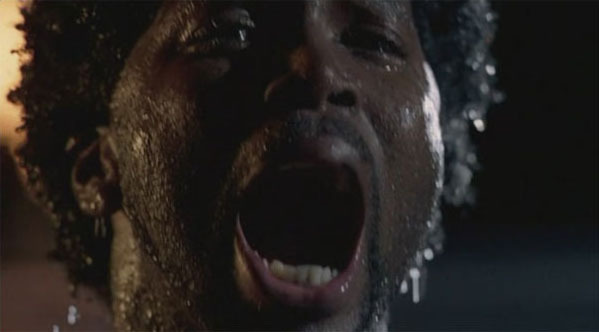
WAAAAALLLLTTTTTTtttttttt....!!!

But then came the part of Monsters of Men that I thought was inexcusable, the reason I'm writing this review. 1017 comes upon Todd and Viola on the beach after the Mayor's suicide (spoilers!) and thinks Todd is the Mayor, so shoots him. Todd is established as being dead. 1017 is shown to be devastated over this even though Todd is a member of the species who enslaved him and killed thousands of his people. (But the colonists will be good THIS time! Pinky swear!) Meanwhile, Todd comes back from the dead, and at the end of the book is in a vegetative state that we're led to believe is temporary. So basically, Ness led us down a path where the plot seemed to dictate that Todd HAD to die, he had to die to leave us with the knowledge that war can be so devastating that it can up and kill one of your main viewpoint characters, and then totally ruined that ending. What a freakin' copout, and I daresay it wouldn't have happened in a book not marketed as YA.

So yeah, the plot was disappointing, but so were a lot of other elements. While I don't like to be "that person" who whinges about improper science in my science fiction books, the question about why women don't have Noise gnawed at me and the fact that it wasn't answered was like breaking Rule #1 of creating your science fiction world. It can be a bullshit explanation (and what SF explanations aren't?), but it has to be there, or at least be commented upon. At the end, it's assumed that the men and Earth animals will join with the Spackle in some hippy-dippy communal voice that will create a peaceful paradise lasting for all time... but when Viola asks "hey, what about the ladies?" it's merely hinted that they'll, like, learn how to use Noise. Stop bothering us with your stupid questions, girlie!

Also totally missing from the book is any mention of religion, except that their religion is what caused the colonists to take the oh-so-convenient step of destroying links to Old Earth. It's gotta be Christianity due to the colonists being almost all white and the houses of worship being called "churches," but no link is made between the original religious motivation for colonization and the consequent falling apart of society due to the gendercide and resultant fallout. You know what might have been interesting? Using the church as an explanation as to why it was so easy for the men to overpower the women despite their silent advantage, because paternalistic Christianity taught them to obey men. But that would have unsettled some Christian readers, I imagine, and been too "heavy" for a YA book.

One bright spot is the fact that there are several same-sex couples in this book handled without fanfare, both human and Spackle, although I really wondered how this fits in with the fact that the colonists are supposed to be religious fundamentalists. Perhaps New World was founded by fanatic Universal Unitarians? It's cancelled out, however, by the gender essentialism: my "looking for scientific answers in a YA book" mind originally assumed that all the native species on the planet were one-sex, which would have simplified the mechanics surrounding Noise, but instead the way Noise is handled made it seem like XX human beings were some kind of freaks. I think it speaks to a lack of imagination that the Spackle race has two sexes (although they don't appear to have gender). There are apparently no trans* humans on New World so I don't know how Ness would have dealt with their Noise.

So while I could have recommended the first book gladly, I can't really recommend the series, and unfortunately TKONLG ends with a major cliffhanger. I don't think this book will put me off YA entirely, but I think that this pattern of "excellent first book, okay second book, terrible third book" is something I've seen a LOT in the YA series I've read over the past few years: the aforementioned Hunger Games, the Uglies series. The underrated City of Ember remained at a high point throughout, but it's the only example I can think of right now. So maybe the rule for YA should be, read the first, make up your own ending? That sits a little too close to fanfiction for this extremely infrequent book reviewer.

Thursday, March 17, 2011

Why I Don't Write (Many) Reviews

Man, I am just a blogging machine these days.

Let's talk about reviews. Specifically, why I don't write them. Because I don't. Write them, that is. It might sound strange that I feel this way, seeing as how I'm married to someone who writes not one but two review blogs (one for comics, one for other books), and I have friends who write review blogs, mostly books, but also film, music, products, etc. And of course there are lots of people active on Goodreads or the Amazon forums or whatnot. But personally, I can't/don't/won't write them, unless we're including sarcastic reviews like my Sliders recaps.

For one, unless something is a total piece of crap, I have an incredibly hard time reviewing it. Because, what do you say? For me, a positive recommendation is something more along the lines of "you should read this, it's awesome." "Well, why should I read it?" "Um... because it's awesome?? Just trust me on this, dude." Saying an author is lyrical, transcendent, has a fine way with words, is a voice of their generation -- all that stuff is well and good, but it doesn't really mean anything, does it? Positive reviews boil down into one sentence: "Based on my own idiosyncratic tastes, I think this is a worthwhile book to read." So that review can only be trusted if you and the reviewer have shared tastes, and this says more about the review writer than the book in question. I can get better recommendations by perusing the current book/music habits of those people with similar tastes (which, ironically or probably not, doesn't sync up much/at all with my friends and especially my husband) than by reading reviews.

Also, positive reviews don't leave much room for biting, snarky commentary, which let's face it, is my blogging "style" if, indeed, I have one at all. Positive reviews require sincerity, and sincerity is not one of the redeeming features of my Internet Persona. There are just fewer ways to jazz up a positive review than a negative one; you can say something like "she wrote that book like your momma bakes chocolate chip cookies... very well!" but that seems forced. But there is no limit to the insulting phrases one can use to tear down someone else's treasured creation. The function of my blog isn't to be informative, it's to be entertaining (even if only to myself), and I am not entertained by positive reviews. That probably speaks to my limitations as a reviewer, but since I don't care about getting better at writing reviews, I can live with it.

So now we get into negative reviews. I will admit that I love writing me some negative reviews, even if they have the potential to ruin my career. But here's the thing: unless I had to read a book, which assumes that I'm a paid reviewer or something of that ilk, I'm probably not going to continue reading it if it's really that awful. Yeah, I read the Hunger Games trilogy, which I thought was pretty awful... but if I finished it, was it really that awful? So once again, we get into nothing to say that isn't based on my own opinion, which clearly can't be trusted if I finished the dang thing. (This is less true when it comes to movies or television, because it takes a lot less time to watch a crappy movie than finish a crappy book, so I'm less likely to bail. Unless falling asleep is a form of bailing.)

The last but maybe most important reason I don't write reviews is that it takes so much time. Way more time than writing a blog entry, or even some fiction of my own, because unlike blogging and fiction, I don't have a strong drive to write reviews, they're like school assignments. In Killing Yourself to Live, Chuck Klosterman said something along the lines of "I don't read books, because reading takes as long as writing, and I get paid to write." Every hour I might spend writing a review (and it would take me that long to maybe write half a review) is an hour I don't spend writing original fiction, or reading. That's too much of a sacrifice to make, especially for a positive review, otherwise known as a review that isn't funny.

So, if I ever write a review, expect it to be both totally negative and have way more to do with me than with the product in question. Basically you don't want me to review your book/album/film, unless it's with the one-word description of "awesome," my highest imaginable praise.

Thursday, February 10, 2011

Sliding Into Mediocrity: The suck must flow

The episode "Paradise Lost" of the just-barely-above-basic-cable (back in the pre-Mad Men days) television show Sliders is usually considered the worst episode of the series by its still-active fanbase. While I think there are others that are worse (the vampire rock band episode and the Island of Dr. Moreau "homage" come to mind), it's really a question of degree. It is, however, undoubtedly an extremely bad hour of television, and because I'm watching it, that means you don't have to. Aren't I a nice person?

We open on a shot of some random dude making a call warning of seismic activity in the area. What area? Where are the eponymous Sliders? When are we going to get to the fireworks factory? At this point in the series run, they weren't even bothering with the alternate history anymore, unless "this world has a giant rubber monster in it, and Earth Prime does not" counts as alternate history. Some extras from the movie Tremors swoop in on the dude and throw him onto the beach, where he is eaten by the worm from Tremors.

Yes, that's right: the producers of this show thought it would be a good idea to write a Tremors tribute, with shades of Dune.

At this point, the Sliders finally show up, just in time (natch) to save a woman who is either hiding something or a really bad actress from one of the Tremors extras. She drives them to a town called Paradise, which you'd know is a bad sign even if the episode wasn't called "Paradise Lost." Has there ever been a fictional town named Paradise, or Heaven, or Idyll, that didn't turn out to have some horrible secret? People should really start reading their TV Tropes before they start barreling into small towns with peaceful names.

The Sliders need some cash, so of course it's up to the woman and the black guy to do menial food service work while the Professor and Quinn get to have real adventures. The bad actress (whose name I still don't know, even though I've rewound Hulu three times) is concerned about the man from the cold open, so Quinn volunteers to help her find him, no matter how long it takes. I don't think I personally would have gotten so chummy so fast with someone I didn't know, even if he did save me from a meth-head. Use your comically oversized 1990s cell phone to call for help, sure. But a multi-day search-and-rescue mission? Thanks for the offer, guy, but that's going far past the call of duty.

We cut to a crime scene of a dead body covered in blue ooze (foreshadowing!). A cop with feathered hair remarks that "she's getting hungrier" (foreshadowing!), and orders the collection of the ooze. The genius Professor just cops to the fact that there is nobody in the town over 30 (foreshadowing!) and that there are almost no recent deaths in the town cemetery (could it be... foreshadowing?!). At this point, you have every piece of information you need to put together the mystery. Unfortunately, there is still forty minutes left to go.

Wade follows the Paradisites to a creepy basement where she witnesses an occult ceremony right out of Lovecraftian horror... except it's totally lame. Now, reality check: the townsfolk don't want the "outsiders" to witness this ceremony, right? Yet they failed to lock the door; the only barrier to entrance was a "closed" sign, which is so ridiculous that I had to pause Hulu for a minute. And even if there weren't any known outsiders in town, wouldn't you lock it anyway on the off chance someone DID wander into town? Of course, I wouldn't be nitpicking these details if the episode was legitimately scary or good. So, note to writers: if you can't write an airtight plot, at least try to write WELL. And vice versa.

So anyway, there is this ceremony with candles and chants and the townsfolk eat the gunk that got spit up by the sandworm from Dune, which shows that the sandworm really got typecast and should have had a better agent. The spice gift grants its users long life, although at the expense of their common sense, since otherwise they would have locked the damn door. Meanwhile, the sandworm eats the Professor. I've since realized that Jonathan Rhys-Davies' uncharacteristically horrible acting in this episode is because this was the last episode before he was killed off for real. So I can't blame him for this awful scene; I only hope he got to steal a lot of office supplies before someone walked him out to his car.

The Sliders not yet written out of the show and Laurie (bad actress from the opening scenes--remember?) go to the sandworm's cave lair and it's all very anticlimactic. Rhys-Davies, a Shakespearean actor, is freed from a layer of literal Saran wrap, the sandworm's "suspended animation." The Sliders decide to blow up the cave and its inhabitant with the explosives they just have for some reason (seriously, I rewound to see if they provided an explanation for having several pounds of plastic explosives just sitting around... they did not), and there is some truly awful CGI footage of the sandworm eating the feathered-hair cop.

They just weren't trying.   
In closing, this is bad. So bad I can't believe I watched it again to recap it. In fact, I don't even know if I still stand by my assertion that this isn't as bad as the Dr. Moreau episode; it's probably worse. As stated, I can give Rhys-Davies a pass for his bad acting here, but that excuse doesn't hold for anyone else involved in the writing, production, or special effects for this episode. No more sandworm death-meth for you, writers of low-budget mid-1990s action/sci-fi shows. You've had too much of a good thing.

Thursday, December 23, 2010

Christmas is a time for nitpicking TV shows

Well, Christmas is almost upon us. I really don't get the logic behind holding a festive holiday in the worst season, and as such I'm not a big fan of Christmas. Nevertheless, I did a little bit of decorating, picking up a bright pink tree at Target, which led the cashier to ask "what are you going to use this crappy little tree for, I mean look at this thing!" "Um, it's going to be my Christmas tree." She was incredulous, saying "oh no, honey, you want a BIG tree." But one of our cats likes to crawl up big Christmas trees, and anyway, they are a pain to set up and tear down. So, crappy little tree it is! (And yes, said cat has still managed to knock it over like five times, which is partially why there are no ornaments on it.)

I also attempted to make a gingerbread house, which was foiled when I managed to break the roof, and dinosaur-shaped sugar cookies, which I managed not to break, but did manage to eat within 24 hours after baking. I am not at all domestic, but Christmas can kind of be a way to pretend that I am.

Thanks to the magic of Hulu, I was also able to get into the holiday spirit this year by watching the Christmas episode of Sliders, a television show I appreciate both ironically and non-ironically (most of my TV watching is ironic, by the way). I don't think I've seen this episode since it originally aired. So anyway, inspired by Chris Sims' recaps of holiday episodes of Xena: Warrior Princess and Walker, Texas Ranger, I present the following recap of "Season's Greedings," the Sliders Christmas episode.

For those unfamiliar with the show--which I'm going to assume is almost everyone reading this blog--it follows four adventurers as they travel to alternate dimensions where small changes in history can lead to worlds either very similar to or very different from our own on "Earth Prime." In the first two seasons, this meant largely alternate history stories that were generally well done. In the third and later seasons, however, the alt-history pretense was dropped and it became just another CGI-laden adventure show which had a tendency to kill off characters for absolutely no reason.

The Christmas episode is near the beginning of the third season, which means that it's only alt-history in the flimsiest sense ("what if... everyone lived in a mall... in the SKY?!"), but is not as horrible as the episodes that come after a certain character, Prof. Maximillian Arturo, is killed off. That character is played by John Rhys-Davies, a classically-trained scene-chewer better known by most nerds (neeeerrdss!!) for playing Gimli the dwarf in Lord of the Rings. I don't really remember his part since I slept through most of Lord of the Rings.

ANYWAY. This episode is Arturo-centric, which means that already it was destined to be at least a moderately entertaining episode. After escaping a world of jealous "pygmies" (their word, not mine), the Sliders decide to give thanks at a denominational chapel, where they arrive just in time to help a woman abandon her baby. The Professor ignores his own Prime Directive and vows to find the mother, and takes the gang to a mall suspended on a cloud in the sky. Now, you'd think that a civilization which has learned to defeat gravity would do more with this technology than stick malls into the sky for absolutely no reason, but perhaps I'm expecting too much realism from a show about interdimensional wormholes.

At the mall, the Sliders bemoan this world's consumerism, which actually doesn't seem much more brash than our consumerism. The alt-mall is not really that much more flashy or decadent than any real mall around the holidays, and as it was filmed in a real mall, there's a fair amount of product placement, making the complaints about consumerism (and later, subliminal advertising) a little hypocritical.

You can't pay for housing or food with cash on Debit Card World, so the team gets hired to work at the mall by Wade's (the cute, petite lady Slider who you shouldn't get too attached to, because yeah...) alt-sister Kelly, whose hairstyle and shoulder pads are imported from alt-1987 (unless part of the alternate history here is that Dallas never went off the air). On an exposition walk-and-talk, the mall manager describes the debt-slave setup of the mall, where you can be fired and kicked out of your mall-provided housing for not spending enough money. This is illustrated by a scene where someone is reprimanded for saving money, which again, doesn't seem all that outrageous if you know anything about the history of company towns. Or maybe it's supposed to be an obvious parallel?

More outrage over this world's rejection of the true meaning of Christmas in favor of rampant consumerism follows, as Arturo (playing Santa Claus) bores the greedy children of Debit Card World with morality tales, until he spots Carol (oh, brother), the baby-dumping woman from the first scene. She, however, manages to fend him off with a janitor's cart pushed strategically in his path. Arturo then decries this as one of the worst worlds they've landed on, which seems a little rash considering they have already landed on a world that's a giant prison, and a world run by J. Edgar Hoover. But that doesn't hold a candle to forgetting the true meaning of Christmas.

The conspiracy B-plot deepens, as Quinn (for the newbs, he's the boy genius who invented sliding) and Arturo find out that Carol is a debt-slave, and Rembrandt (comic relief/everyman character) becomes addicted to shopping through subliminal advertising. Quinn then preaches to alt-Kelly about the artificiality of Debit Card World's Christmas. Case in point: they don't even use real Christmas trees! Of course, I don't know anyone who DOES use a real Christmas tree, and it wouldn't make any sense to use a real tree in a mall anyway. But I guess this is supposed to demonstrate Earth Prime's moral superiority over other dimensions, with our subtle, understated celebration of Jesus' birthday.

We're then treated with more first-class acting by Rhys-Davies, who tries to guilt Carol (oh, brother) into taking back her baby by recounting his mother's death in the blitzkrieg, and the terrible abandonment fears he now has, which is ironic if you remember that he abandoned his own son. Or maybe the writers just forgot that bit of character history. This is the third season, they just didn't care. The C-plot, involving Wade and her alt-family, chugs along. That plot isn't very interesting.

The crux of the mass consumerism and debt slavery is revealed to be the subliminal advertising in the commercials, which isn't really subliminal advertising since the messages are on the screen long enough for you to see/read them consciously, and anyway, subliminal advertising doesn't work and especially wouldn't work on a large scale. Again, I'm nitpicking at a show about interdimensional travel. But it's a lot easier to get me to suspend belief over something that just doesn't exist than to believe in something that's been proven NOT to exist.

Anyway, it's Sliders to the rescue, as Carol (oh, brother), Quinn, and Wade break into the mall president's office and randomly pound on his computer keyboard, which as we all know from 1990s sci-fi, will get you into any computer security system, no matter how guarded. Meanwhile, Arturo continues to indoctrinate the children of Debit Card World with his tales of the real meaning of Christmas. He self-righteously tells the mall president that his reign of consumerism is over now that children have been instructed about “true values,” showing that Arturo has perhaps too high an opinion of most children's attention spans. Seriously, these kids aren't going to remember being told a Christmas story by John Rhys-Davies, no matter how classy his voice is.

Finally, there is a confrontation between alt-Kelly, Quinn, and the mall president, and Quinn socks the president in the jaw, since pretty much every season three episode had to end with some kind of fight or chase (there is also a short chase). Everyone convenes at Wade's alt-family's house for sappy songs and recollections.

Preachiness aside, this is a decent episode, especially considering that it's in the third season. If I do more of these sarcastic Sliders episode recaps, I'll have to pick a really awful episode like the Dune or Island of Dr. Moreau homages.

Anyway, happy holidays, readers!